

OPTIMAI - AI-Driven Production Planning for Precision Gear Manufacturing
Fabrica de Engranajes Lorenzo is a family-run SME located in Toledo, Spain, with more than three decades of experience in precision gear manufacturing. The company serves customers primarily in the automotive and industrial sectors, producing high-quality components while continuously investing in innovation and technology to remain competitive in a demanding manufacturing environment.
As part of the OPTIMAI experiment within AIRISE, Fabrica de Engranajes Lorenzo sought to improve its production planning and resource allocation processes. By integrating artificial intelligence into its existing shop floor management system, the company aimed to optimize scheduling decisions, improve operational flexibility, and increase overall production efficiency.
Smart Production Planning
AI-driven Scheduling and Resource Optimization
As a growing manufacturing SME, Fabrica de Engranajes Lorenzo faced challenges related to production planning, scheduling, and resource management. Existing planning activities required significant manual intervention, making it difficult to react quickly to changing priorities, machine breakdowns, and unexpected customer demands.
Manual planning processes were time-consuming and often limited the company's ability to optimize machine utilization and delivery performance. While the company recognized the potential benefits of artificial intelligence, it lacked the internal expertise required to evaluate, implement, and manage AI technologies effectively.
The company needed a practical solution capable of supporting real-time decision-making while fitting the operational realities of a small manufacturing business.
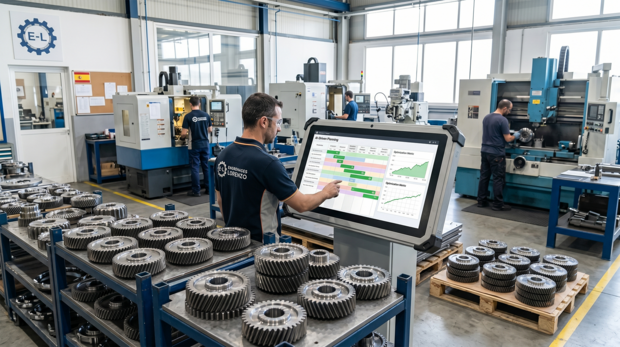
Within the AIRISE OPTIMAI experiment, an AI-powered planning module was developed and integrated into Fabrica de Engranajes Lorenzo existing shop floor management software.
The solution automatically generates and evaluates production planning scenarios based on real-time operational constraints, including machine availability, workload distribution, delivery deadlines, and available resources. The system assists planners by proposing optimized schedules that can rapidly adapt to changing production conditions.
Throughout the implementation process, AIRISE provided technical mentoring, project guidance, and support in defining realistic key performance indicators. Particular attention was given to ensuring transparency and usability through explainable AI approaches, helping planners understand how recommendations were generated and increasing confidence in the system.
The collaborative development process enabled the company to integrate AI into its existing workflows while minimizing disruption to day-to-day operations.
- More Dynamic and Responsive Production Planning:
- The AI system automatically generates planning scenarios based on real-time production constraints.
- Planning activities that previously required extensive manual adjustments can now be completed significantly faster.
- The company can respond more effectively to disruptions such as machine breakdowns and urgent customer orders.
- Improved Resource Utilization and Operational Efficiency:
- Production schedules are better aligned with actual manufacturing capacity and resource availability.
- Improved planning accuracy supports more efficient use of machine time and workforce allocation.
- The system helps reduce overtime requirements while maintaining delivery commitments.
- Enhanced Decision-Making:
- AI-generated recommendations support planners in making faster and more informed decisions.
- The integration of real-time operational data enables more flexible and adaptive production management.
- Improved planning reliability contributes to stronger delivery performance and customer satisfaction.
- Increased Confidence in AI Adoption:
- The project demonstrated that AI technologies can be successfully implemented within a small manufacturing enterprise.
- Employees gained practical experience with AI-supported decision-making processes.
- The initiative helped foster a culture of digital innovation and continuous improvement throughout the organization.
Following the success of the OPTIMAI experiment, Fabrica de Engranajes Lorenzo plans to continue expanding the use of AI across its operations.
Future applications under consideration include predictive maintenance, cost estimation, and additional production optimization capabilities. The company also intends to remain actively engaged within the AIRISE ecosystem to continue learning from other industrial users and emerging AI solutions.
The project has transformed the company's perception of artificial intelligence, demonstrating that advanced digital technologies can deliver practical and measurable benefits for SMEs. Long-term, Fabrica de Engranajes Lorenzo sees AI as an important tool for improving competitiveness, increasing operational agility, and supporting the ongoing digital transformation of its manufacturing processes.