

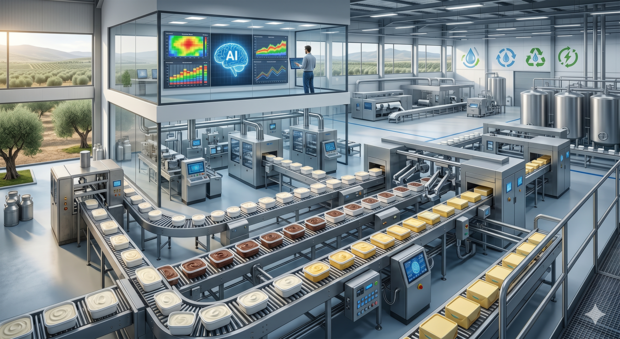
CREAM AI - AI-Driven Production Scheduling for Dairy Manufacturing
KEFIS S.A. is a small family-owned food manufacturer based in Arta, Greece, operating in the dairy industry. The company specializes in the production of cream cheese products, including salted and unsalted varieties, chocolate cream cheese products, and margarine. Its current cream cheese production line processes approximately 7–9 tonnes per day, with plans underway to transfer production to a new facility currently under construction.
As part of the CREAM AI experiment within AIRISE, KEFIS S.A. sought to improve its production planning and scheduling processes. By introducing an AI-based production scheduling tool, the company aimed to reduce cleaning operations, minimize downtime, improve production efficiency, and support more sustainable use of resources while maintaining product quality.
Smart Food Manufacturing
AI-driven Production Planning and Scheduling
As a small family-run manufacturer, KEFIS S.A. relied heavily on manual production planning processes, often using spreadsheets to organize daily operations. This approach resulted in frequent schedule changes, increased cleaning requirements, production inefficiencies, and challenges in responding quickly to changing priorities.
Operational data were fragmented across multiple files and formats, making it difficult to gain meaningful insights or optimize production planning. The company also sought to reduce energy and water consumption while maintaining consistent product quality and meeting customer demand.
A significant challenge during the project was the quality and consistency of existing production data. Information was distributed across multiple Excel files, often containing missing values, inconsistent product names, and undocumented production and cleaning rules.
Within the AIRISE CREAM AI experiment, KEFIS S.A. tested a web-based AI production scheduling tool designed specifically for batch planning in cream cheese manufacturing.
The solution allows users to upload production orders through simple Excel files and automatically generates optimized production sequences. The AI scheduler minimizes product changeovers and cleaning operations while respecting production constraints, shift calendars, and priority orders. It also supports rapid rescheduling when new orders are introduced or production conditions change.
To enable implementation, the company worked closely with AIRISE partners to clean, standardize, and map production data into a simplified structure. Tecnalia customized and hosted the web-based solution, allowing KEFIS S.A. to access the system through a standard web browser without requiring additional infrastructure investments.
Training sessions and continuous support ensured that company personnel could effectively test, evaluate, and understand the benefits of AI-assisted planning.
- Improved Production Planning Efficiency:
- The AI scheduler automatically sequences production batches to reduce unnecessary product changeovers.
- Production planning activities became faster and more structured compared with manual scheduling approaches.
- The system allows rapid evaluation of alternative planning scenarios and supports more agile decision-making.
- Reduced Cleaning Requirements and Downtime:
- Optimized production sequencing helps minimize cleaning operations between product batches.
- Fewer changeovers contribute to reduced production downtime and improved equipment utilization.
- The scheduling approach supports more stable and predictable production operations.
- Better Data Utilization:
- The project helped consolidate fragmented operational data into a more structured and usable format.
- Improved visibility of production constraints and planning requirements enabled more informed decision-making.
- The company gained valuable insights into the importance of data quality as a foundation for AI adoption.
- Increased Digital Readiness:
- The experiment provided KEFIS S.A. with its first practical experience in applying artificial intelligence within manufacturing operations.
- Employees gained a better understanding of AI capabilities, limitations, and implementation requirements.
- The project demonstrated that AI technologies can deliver practical value for small and medium-sized food manufacturers.
Following the completion of the CREAM AI experiment, KEFIS S.A. plans to build on the knowledge and experience gained during the project by further improving its production planning processes and data management practices.
In the short term, the company intends to continue applying optimized sequencing rules to reduce unnecessary cleaning operations and improve production efficiency. In the longer term, KEFIS S.A. will evaluate the adoption of more advanced AI-driven planning tools similar to those explored during the AIRISE experiment.
The project marked an important first step in the company's digital transformation journey, providing valuable insight into both the opportunities and challenges associated with artificial intelligence. Moving forward, KEFIS S.A. sees AI as a practical tool that can support more efficient, sustainable, and data-driven manufacturing operations while helping the company remain competitive in a rapidly evolving food industry.